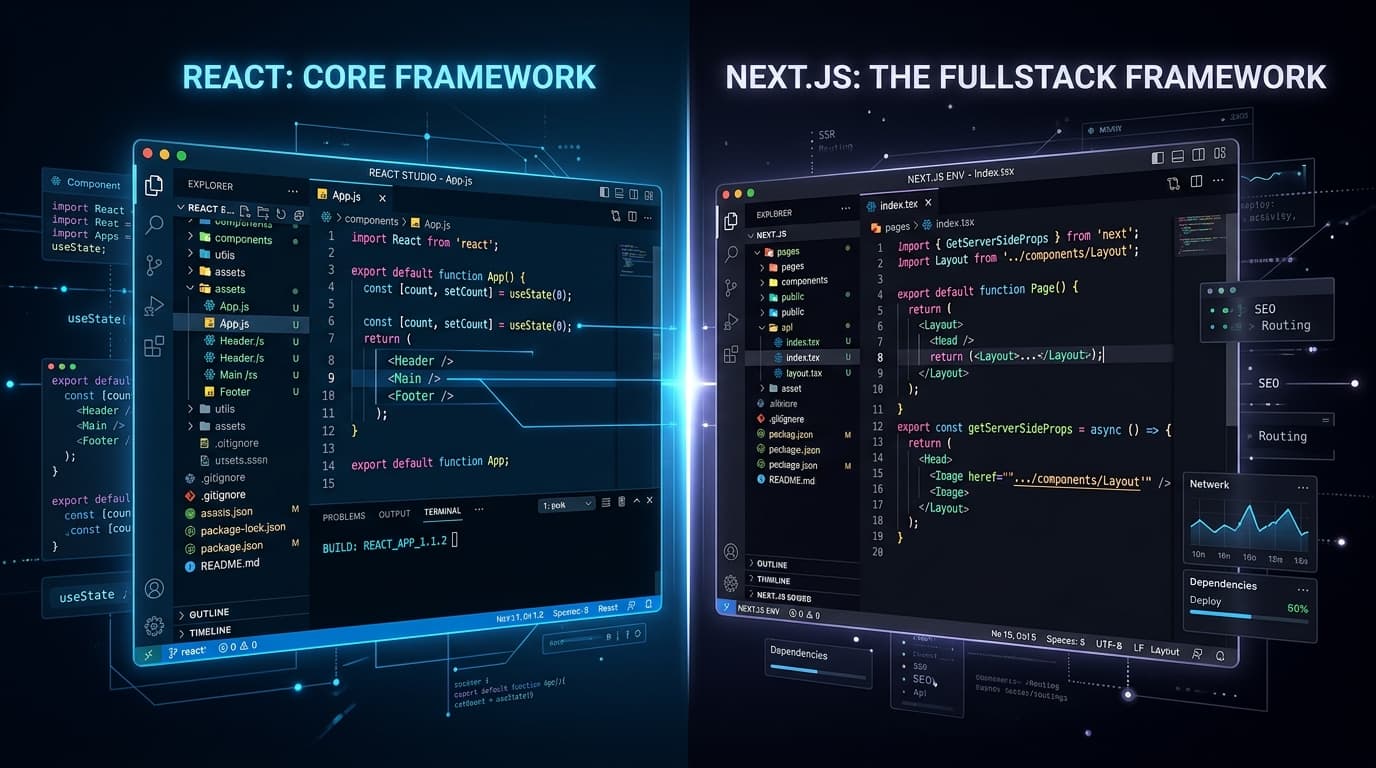
"Should we build this with React or Next.js?"
As a Senior Full-Stack Architect, this is the most common question I get from startup founders and tech leads when kicking off a new project. In 2026, the landscape of web development has shifted dramatically with the maturity of the Next.js App Router and React Server Components (RSC).
The short answer? It depends entirely on your product goals.
Here is a definitive guide to help you make the right architectural choice for your MVP.
1. Traditional React (SPA): The Client-Side King
A Single Page Application (SPA) built with Vite and pure React ships an empty HTML file to the browser, followed by a massive JavaScript bundle that builds the UI on the user's device.
When to use a React SPA:
- Internal Dashboards: If you are building a B2B admin panel hidden behind a login screen where SEO does not matter.
- Highly Complex State: Applications like Figma, video editors, or complex web games where everything happens instantly on the client.
- Mobile App parity: If you are sharing heavy logic with a React Native app.
The Downside: SPAs are terrible for SEO because web crawlers see a blank page. They also suffer from slower initial load times (a blank white screen) on slow mobile networks while the JS bundle downloads.
2. Next.js App Router: The Enterprise Standard
Next.js is a meta-framework built on top of React. It moves the rendering process from the user's phone to your powerful cloud server. It sends fully formed HTML to the browser, which makes the page load instantly.
When to use Next.js:
- E-commerce & SaaS: If your product needs to rank on Google to survive, you must use Next.js for its Server-Side Rendering (SSR) and perfect SEO.
- Content-Heavy Sites: Blogs, news platforms, and marketing landing pages.
- Fast First Paint: If you want your users to see the UI instantly without staring at a loading spinner.
- Full-Stack Needs: With Next.js
app/apiroutes and Server Actions, you can build your backend directly inside the same repository, eliminating the need for a separate Node.js server.
// Example of a Next.js Server Component fetching data directly from the DB
// This never ships JavaScript to the client!
import db from '@/lib/db';

export default async function Dashboard() {
  const users = await db.query('SELECT * FROM users');

  return (
    <ul>
      {users.map(user => <li key={user.id}>{user.name}</li>)}
    </ul>
  );
}
3. The Architect's Recommendation for 2026
If you are starting a new project today, default to Next.js.
The React core team themselves recommend using a framework like Next.js for new applications. With the introduction of React Server Components, Next.js gives you the best of both worlds: you get instant server rendering for SEO and performance, but you can still use traditional client-side React ('use client') for complex interactive components when needed.
Building an SPA in 2026 using Vite is perfectly fine for hobby projects or strictly internal tools, but for a public-facing startup aiming to scale, Next.js is the undeniable standard.
Need an architect to help launch your next startup idea? Check out my Services or reach out directly!