A common misconception among local service providers and small-to-midsize business owners is:
"I already have an Instagram page and a Google Maps profile. Why should I invest in a custom website or dedicated landing page?"
It is an understandable question. Setting up a social profile is free, and creating a Google Business Profile (GBP) takes less than thirty minutes.
However, relying entirely on third-party platforms is the digital equivalent of building a million-dollar storefront on rented land.
Algorithms change without warning, platform rules shift overnight, accounts get suspended without recourse, and worst of all, third-party platforms are intentionally engineered to showcase your competitors right next to your profile.
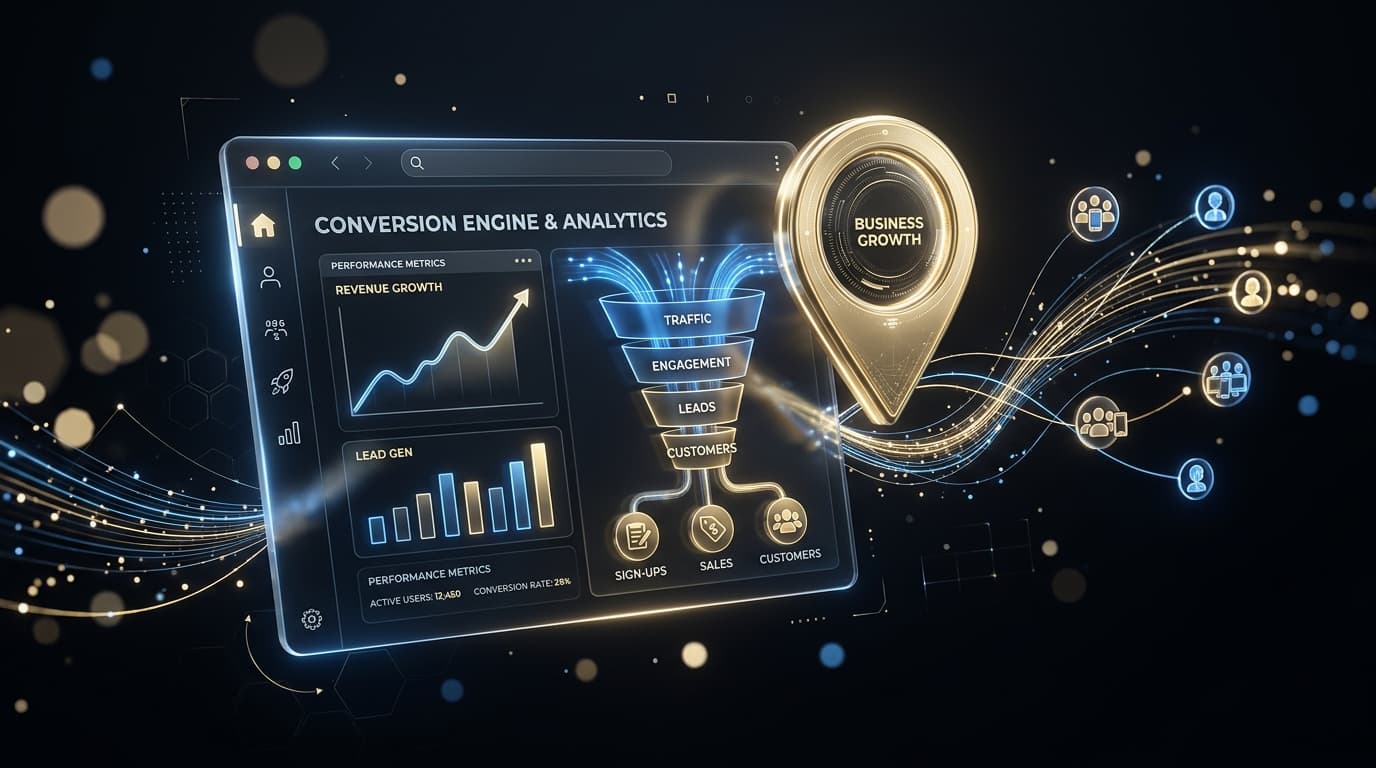
In 2026, a high-performance website or dedicated landing page is not an optional aesthetic luxury. It is your primary owned digital asset, your 24/7 automated sales representative, and the ultimate conversion engine that transforms casual browsers into high-paying, committed clients.
In this comprehensive guide, we will unpack:
- Why a dedicated website or landing page is fundamentally indispensable for your business.
- The exact channels through which qualified customers discover and land on your website.
- The step-by-step conversion mechanics that turn anonymous visitors into paying customers.
- A deep comparative breakdown: How a website differs from Google Business Profile (GBP / GMB).
- The Synergy: Why pairing GBP with a fast, modern website creates an insurmountable local monopoly.
- The 2026 High-Converting Website Checklist.
1. Why a Website Is Essential: Rented Land vs. Owned Real Estate
When you conduct business exclusively on Instagram, Facebook, or even Google Maps, you do not own your audience or your digital storefront. You are merely a tenant.
┌────────────────────────────────────────────────────────────────────────┐
│                   DIGITAL ASSET CLASSIFICATION                         │
├───────────────────────────────────┬────────────────────────────────────┤
│      RENTED PLATFORMS             │       OWNED ASSET                  │
│   (Instagram, Facebook, GBP)      │   (Your Custom Website)            │
├───────────────────────────────────┼────────────────────────────────────┤
│ • Zero control over algorithm     │ • 100% control over design & UX    │
│ • Competitor ads shown on profile │ • 0% competitor ads or distraction │
│ • Account can be suspended        │ • Permanent, un-cancellable asset  │
│ • Restricted layout & templates   │ • Infinite custom functionality    │
│ • You rent audience attention     │ • You capture first-party data     │
└───────────────────────────────────┴────────────────────────────────────┘
Here is why having an independent website is non-negotiable:
1. Instant Trust & High-Ticket Credibility
Consumer psychology has shifted dramatically. When prospective clients consider hiring a doctor, interior designer, contractor, lawyer, or high-end service professional, they do not base high-ticket financial decisions solely on a social post.
Research consistently demonstrates that over 84% of consumers believe a business with a dedicated website is substantially more credible and professional than one operating exclusively on social media. A domain name (yourbusiness.com) and clean web architecture communicate permanency, legitimacy, and serious business intent.
2. The 24/7 Virtual Sales Representative
Your physical storefront or office closes in the evening. Your staff goes home. But prospective clients do their research after work—often between 8 PM and midnight while browsing on mobile phones.
A modern website works continuously without fatigue:
- It explains your unique value proposition.
- It proactively answers common objections and pricing questions.
- It displays verified customer case studies.
- It automatically captures qualified leads, booking appointments directly into your calendar or sending instant inquiries via WhatsApp.
3. Freedom from Algorithmic Whims
Social media platforms exist to maximize user retention on their app, not to grow your business. Organic reach on social networks now hovers below 2–3%. When an algorithm update de-prioritizes your posts, your pipeline dries up.
Your website, conversely, is an asset you own completely. No algorithm can ban your website, hide your contact information, or demand that you pay "boost fees" just to show your services to your existing customers.
2. Traffic Architecture: How Customers Actually Land on Your Website
A website is useless if nobody sees it. To build a reliable revenue stream, you need to understand the five primary acquisition channels that bring qualified prospects to your digital front door:
graph TD
    A[Prospective Customers] --> B[1. Google Organic Search / SEO]
    A --> C[2. Google Maps / GBP Website Link]
    A --> D[3. Paid Search & Social Ads]
    A --> E[4. Social Profiles & Direct Bio Links]
    A --> F[5. Word-of-Mouth, QR Codes & Referrals]
    B --> G[High-Performance Website / Landing Page]
    C --> G
    D --> G
    E --> G
    F --> G
    G --> H[Converted Paying Customers]
Channel 1: Google Organic Search (Topical SEO)
When consumers search for answers to their problems, they don't type brand names—they type problem queries:
- "Cost of full home interior renovation"
- "Best pediatric dental clinic for toddlers"
- "Commercial electrical compliance checklist"
By publishing authoritative content, localized service pages, and case studies on your website, you capture users at the exact moment they are seeking educational or commercial solutions. Once they land on your site, they recognize your expertise and transition from information-seekers to qualified clients.
Channel 2: The Google Business Profile Multiplier (Maps to Web)
When people discover your business in the Google Local 3-Pack, approximately 45% of users tap "Call", but over 50% tap "Website" first.
Why? Because today's buyers are cautious. Before calling, they want to see:
- Real project portfolios and photos of completed work.
- Clear service breakdowns and pricing transparency.
- The company's background, team credentials, and guarantees.
Your Google Business Profile initiates local discovery; your website secures the conviction needed to close the deal.
Channel 3: Targeted Paid Advertising (Google Ads & Meta Ads)
If you run paid campaigns on Google Search or Meta (Instagram/Facebook), sending ad traffic to an unoptimized homepage or Instagram profile wastes ad spend.
High-growth businesses direct paid ad traffic to dedicated landing pages:
- The landing page matches the exact intent of the ad keyword (e.g., an ad for "emergency roof repair" links directly to a page focused solely on 24/7 roof repairs, not general construction).
- The page removes navigation distractions, guiding the visitor toward a single conversion action (such as filling out a 3-field quote form or initiating a WhatsApp consultation).
- Targeted landing pages routinely achieve conversion rates of 10%–25%, compared to the typical 1%–2% conversion rate of generic homepages.
Channel 4: Social Media Profiles & Bio Links
Your Instagram, LinkedIn, YouTube, and Facebook profiles should not serve as dead ends. They function as top-of-funnel discovery hubs. Placing a high-converting website link in your bio converts passive followers and casual viewers into email subscribers, phone callers, and booked consultations.
Channel 5: Offline-to-Online Referrals & QR Codes
From physical business cards, storefront banners, fleet vehicle graphics, packaging, invoices, to offline print brochures—a scannable QR code leading to a mobile-optimized landing page bridges the gap between offline interactions and immediate digital conversions.
3. Conversion Mechanics: How Visitors Turn into Paying Customers
Getting visitors to your website is only half the battle. If visitors arrive and leave within five seconds without contacting you, your website is bleeding revenue.
Converting traffic into paying clients requires an intentional psychological architecture:
┌────────────────────────────────────────────────────────────────────────┐
│                    THE 5-STEP CONVERSION FUNNEL                        │
├────────────────────────────────────────────────────────────────────────┤
│  [1. HOOK]      Instant Clarity Above the Fold (5-Second Rule)         │
│         │                                                              │
│         ▼                                                              │
│  [2. TRUST]     Immediate Social Proof & Verified Credibility          │
│         │                                                              │
│         ▼                                                              │
│  [3. VALUE]     Tangible Solution, Benefits & Transparent Process      │
│         │                                                              │
│         ▼                                                              │
│  [4. PROOF]     Case Studies, Before/After Visuals & Real Metrics      │
│         │                                                              │
│         ▼                                                              │
│  [5. ACTION]    Zero-Friction Conversion: WhatsApp / Call / Fast Form  │
└────────────────────────────────────────────────────────────────────────┘
Step 1: The 5-Second Test (Hero Section Clarity)
When a user opens your website on a mobile device, you have exactly five seconds to answer three subconscious questions:
- What do you offer?
- How will it make my life or business better?
- What specific action must I take next?
Weak Example: "Welcome to ABC Solutions. Providing Excellence Across All Horizons." (Vague, uninformative, zero conversion pull).
High-Converting Example: "Turnkey Interior Design for Modern Homes in South Delhi. Delivered in 45 Days with Zero Cost Overruns. [Book Free 30-Min Consultation] or [WhatsApp Us Directly]".
Step 2: Immediate Social Proof Above the Fold
Directly beneath your hero headline, showcase trust signals:
- Customer review ratings (e.g., "⭐ 4.9/5 from 180+ Local Clients").
- Media features, verified certifications, or industry accreditations.
- Prominent client logos or trusted partner badges.
This immediately neutralizes customer skepticism.
Step 3: Zero-Friction Conversion Triggers
Different customers prefer different communication methods. A high-converting website caters to all of them without adding cognitive friction:
- Sticky WhatsApp Floating Button: For mobile visitors who want instant, asynchronous communication without filling out forms.
- One-Tap Direct Calling: Prominently positioned in the mobile header for urgent service requirements.
- Short, Streamlined Lead Forms: Keep forms down to 2 or 3 essential fields (Name, Phone/Email, Service Needed). Every additional form field reduces submission rates by approximately 7%.
- Live Calendar Booking: Enabling prospects to select an exact date and time for a consultation or site inspection eliminates back-and-forth email scheduling friction.
Step 4: Visual Demonstration Over Generic Text
Never tell visitors you are great at what you do; show them:
- Interactive Before-and-After Sliders: Perfect for clinics, remodelers, interior architects, landscape designers, and agencies.
- Micro Case Studies: Document the specific problem the client had, the exact solution implemented, and the measurable outcome achieved (e.g., "How Dr. Sharma's clinic increased patient appointments by 140% in 90 days").
- Video Testimonials: Unedited, 30-second video clips of real clients speaking from their heart possess a conversion power that written quotes cannot rival.
Step 5: Speed & Mobile-First Execution
Over 65% of local service queries occur on mobile phones, often on variable cellular data connections.
- If a website takes longer than 3 seconds to load, over 53% of mobile visitors immediately bounce and click on your competitor's link.
- Modern engineering—using frameworks like Next.js, optimized responsive images, and edge caching—ensures sub-second load speeds, capturing the impatient mobile audience.
4. Google Business Profile vs. Website: A Detailed Comparison
A frequent question asked by local entrepreneurs is: "If I already rank on Google Maps with my GBP, do I still need a website? How are they different?"
While Google Business Profile and a custom website work together, they serve fundamentally different functions in the buyer's journey:
| Feature / Dimension | Google Business Profile (GBP / GMB) | Custom Website / Landing Page | | :--------------------------- | :----------------------------------------------------------------------------------------------------------------- | :-------------------------------------------------------------------------------------------------------------------------------- | | Asset Ownership | Rented: Owned by Google. Subject to algorithm shifts, spam competitor flags, and abrupt suspensions. | 100% Owned: You own your code, database, content, brand identity, and customer records. | | Competitor Distraction | High: Google frequently displays competitor ads and nearby listings directly underneath your profile. | Zero: Once a visitor is on your website, you have 100% of their focus. No competitor ads exist. | | Geographic Reach | Localized Radius: Limited to physical proximity (typically 3 to 15 kilometers around your registered address). | Unlimited: Can rank across multiple cities, entire regions, nationwide, or globally. | | Customization & Branding | Rigid Template: Standardized layout, strict character limits, uniform fonts, and fixed tabs. | Complete Freedom: Tailored interactive calculators, custom portfolios, brand animations, and booking workflows. | | Information Depth | Surface-Level: Basic hours, address, short post snippets, and customer reviews. | Deep & Comprehensive: In-depth case studies, detailed pricing tiers, interactive FAQs, and multi-page guides. | | Data & Retargeting | Basic Insights: High-level metrics on search impressions, map direction requests, and call taps. | Full First-Party Analytics: Google Analytics 4, Hotjar user recordings, Meta Pixel retargeting, and lead nurturing funnels. | | Search Intent | Immediate Convenience: Fast phone calls, physical driving directions, and operational hours. | High-Intent Decision Making: Evaluating quality, comparing packages, verifying track record, and buying high-ticket services. |
5. The Synergy: Why Combining GBP with a Fast Website Creates an Unbeatable Flywheel
The true secret to dominating your market is not choosing between a Google Business Profile or a website. It is integrating both into an interconnected local growth machine.
Google's search engine is an interconnected ecosystem. When the local search algorithm evaluates where to position your Google Business Profile in the Local 3-Pack, one of its primary ranking signals is the quality, relevance, and authority of the website linked to your profile.
graph LR
    subgraph Local Dominance Flywheel
        A[Google Maps Searcher] --> B[Discovers Business in 3-Pack]
        B --> C[Clicks 'Website' to Vet Credentials]
        C --> D[Ultra-Fast Website with Local Schema]
        D --> E[High Conversion: WhatsApp / Call / Form]
        D --> F[Strong Engagement Signals Sent to Google]
        F --> G[Google Algorithm Rewards Higher Map Rank]
        G --> B
    end
How Your Website Supercharges Your Google Maps Rank:
- Topical Authority & Keyword Validation: When your website contains comprehensive pages detailing your services, materials, and processes, Google's web crawler connects those keywords directly to your Google Business Profile entity.
- Local Schema Structured Data: By embedding
LocalBusinessJSON-LD schema within your website code (containing your exact GPS coordinates, business hours, service types, and address), you remove all ambiguity for search engines. - Location-Specific Landing Pages: If your business serves multiple surrounding suburbs or cities, your GBP can only pin one physical address. By creating dedicated location landing pages on your website (e.g.,
/interior-design-gurgaon,/interior-design-south-delhi), you capture search queries across territories far beyond your physical pin. - Behavioral Trust Signals: When visitors click from Google Maps to your website, stay for several minutes exploring your portfolio, and submit an inquiry, Google recognizes that your business genuinely satisfies user intent, cementing your position at the top of local rankings.
6. The 2026 High-Converting Website Checklist
Before launching or redesigning your website, audit it against these proven engineering and conversion standards:
- [ ] Mobile-First Responsiveness: Does the site render seamlessly across all smartphone screen sizes, with tap targets designed for thumbs?
- [ ] Sub-1.5 Second Load Speed: Are images optimized, scripts deferred, and assets served from modern CDNs with 90+ Google PageSpeed scores?
- [ ] Clear Value Proposition Above the Fold: Can a first-time visitor understand what you do and why you are the best choice in less than five seconds?
- [ ] Instant Contact Accessibility: Is there a sticky WhatsApp chat button, a prominent click-to-call icon, and a simple inquiry form on every page?
- [ ] Real Photographic Evidence: Have you eliminated generic stock photos in favor of authentic photos of your actual team, office, and completed projects?
- [ ] Social Proof & Verification: Are customer reviews, star ratings, video testimonials, and client case studies prominently integrated throughout the page?
- [ ] Transparent Pricing or Process Guidance: Does the site clearly explain your process or starting packages so customers feel confident initiating contact?
- [ ] Complete Search Engine Schema: Is your
LocalBusinessJSON-LD structured data properly implemented and validated in Google's Rich Results test tool?
Final Thoughts: Stop Leaving High-Value Clients on the Table
In today's competitive landscape, your business cannot afford to be invisible or rely on platforms where competitors can hijack your audience with paid ads.
Your Google Business Profile is your digital storefront sign—attracting nearby foot traffic and immediate searches.
Your website is your high-converting sales showroom—educating prospects, eliminating objections, proving your authority, and turning curious visitors into long-term, high-value clients.
When both work in harmony, your business establishes a dominant presence that outranks, outconverts, and outlasts local competitors.
Is your current website losing qualified leads, or are you ready to build a high-performance web asset that works for you around the clock? Check out my Web Development Services or Get in Touch for a complimentary digital architecture review.